What exactly are we doing when we gather as churches for worship? And how do we know what we should be doing in those weekly gatherings?
Naturally, evangelical Christians turn to Scripture for guidance on these questions, but where in Scripture do we look? There’s plenty about worship in the Old Testament—about prayers and sacrifices and choirs and cymbals and much else. But does all that material actually apply to new covenant gatherings of believers?
What we need in order to answer these questions is a biblical theology of worship.[1] Biblical theology is the discipline that helps us trace both the unity and diversity, the continuity and discontinuity, within the sprawling storyline of Scripture.
In this article I’m going to sketch, all too briefly, a biblical theology of corporate worship. Four steps will take us there: (1) gathered worship in the Old Testament; (2) fulfillment in Christ; (3) gathered worship in the New Testament; (4) reading the whole Bible for corporate worship.
1. GATHERED WORSHIP IN THE OLD TESTAMENT
Ever since God’s people were banished from his presence after the fall in Genesis 3, God has been at work gathering them back to himself.[2] So when Israel suffered in chains in Egypt, God rescued them not just so that they would be free from oppression, but so that they would worship him in his presence (Ex. 3:12, 18). God led his people out of Egypt and brought them to his own dwelling place (Ex. 15:13, 17).
Where is that dwelling place? At first, it’s the tabernacle, the elaborate tent in which the priests would offer sacrifices for the people’s sins and impurities. We read in Exodus 29:44–46,
I will consecrate the tent of meeting and the altar. Aaron also and his sons I will consecrate to serve me as priests. I will dwell among the people of Israel and will be their God. And they shall know that I am the Lord their God, who brought them out of the land of Egypt that I might dwell among them. I am the Lord their God.
The goal of the Exodus was that God would dwell among his people, and he does this by means of the holy place (tabernacle) and people (priesthood) he appointed for that purpose.


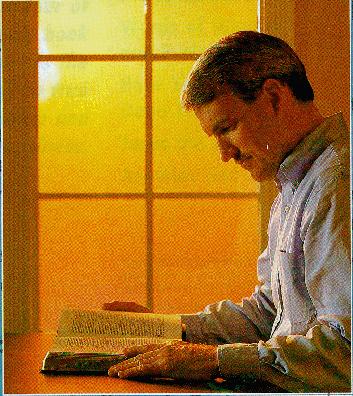 The Bible is a window.
Have you opened it lately?
The Bible is a window.
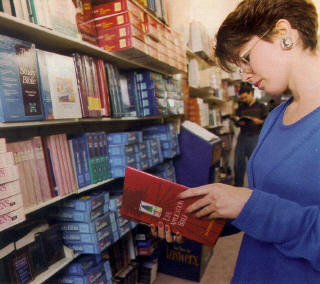
Have you opened it lately?“Americans revere the Bible—but, by and large, they don’t read it,” pollster George Gallup Jr. once observed. This seems to be borne out by what Americans know about the Bible. In one survey, only 42 percent of those interviewed could name five of the Ten Commandments. Only 46 percent correctly named the four Gospels—Matthew, Mark, Luke and John. It is likely that the statistics have gone down since those surveys were taken.
Of course, simple numbers are not important. What is important to know is how the Bible speaks to our lives. “Until people see the Bible as a practical guidebook for their everyday existence, it will probably continue to remain on the shelf,” says Christian trend-watcher George Barna.
So why should we read and study an ancient and (in the minds of many) hard-to-understand book? What could the Bible possibly say that is essential to daily life in the modern world?
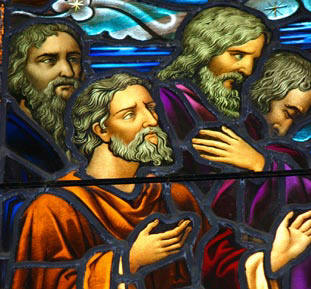 A
"cannon" is an old-fashioned weapon; a "canon" (notice the difference
in spelling) is a list of authoritative books. "Canon" comes from the
Greek word kanon, meaning measuring stick. A rough definition
of canon is "the list of books that can be used in church to teach
doctrine." There were many books and letters written in the early years
of the church. So why do we have these particular books in our present New Testament canon or Bible?
A
"cannon" is an old-fashioned weapon; a "canon" (notice the difference
in spelling) is a list of authoritative books. "Canon" comes from the
Greek word kanon, meaning measuring stick. A rough definition
of canon is "the list of books that can be used in church to teach
doctrine." There were many books and letters written in the early years
of the church. So why do we have these particular books in our present New Testament canon or Bible? The
rector shared some of the highlights of his church’s long history. "It
was in this church that John Wycliffe, our most famous rector,
ministered during the last years of his life, over six centuries ago,"
he said.
The
rector shared some of the highlights of his church’s long history. "It
was in this church that John Wycliffe, our most famous rector,
ministered during the last years of his life, over six centuries ago,"
he said.
 Steve was a house painter from England vacationing at a
beach in the Philippines with his family. I happened to be staying at
the same resort. One day during a conversation that began to turn toward
spiritual things, Steve said, "I've talked to numerous religious
leaders but they've never been able to answer my questions
satisfactorily. So I've given up on religion and am trying to live a
good life."
Steve was a house painter from England vacationing at a
beach in the Philippines with his family. I happened to be staying at
the same resort. One day during a conversation that began to turn toward
spiritual things, Steve said, "I've talked to numerous religious
leaders but they've never been able to answer my questions
satisfactorily. So I've given up on religion and am trying to live a
good life."
 A User’s Guide
 His
name was Jesus of Nazareth, and the world has never forgotten him. Of
him it has been well said that "the names of the past proud statesmen of
Greece and Rome have come and gone. The names of the past scientists,
philosophers, and theologians have come and gone; but the name of this
Man abounds more and more...Herod could not destroy Him, and the grave
could not hold Him" (quoted in Josh McDowell, Evidence That Demands a Verdict, p. 135).
His
name was Jesus of Nazareth, and the world has never forgotten him. Of
him it has been well said that "the names of the past proud statesmen of
Greece and Rome have come and gone. The names of the past scientists,
philosophers, and theologians have come and gone; but the name of this
Man abounds more and more...Herod could not destroy Him, and the grave
could not hold Him" (quoted in Josh McDowell, Evidence That Demands a Verdict, p. 135).

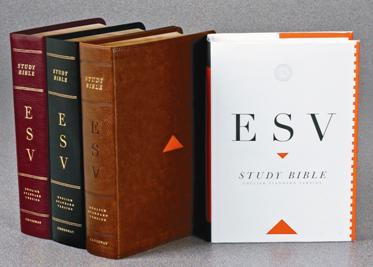
 Starting a Bible Study blog takes a lot of work in my opinion. Writing a Bible study can prove to be a bit more complex because it is after all, a study. That means that you have to study to show thyself approved (2Timothy 2:15 [Open in Logos Bible Software (if available)] ) so that your Bible study has some legs to stand on. Of course, before starting an new project you should pray to make sure it is God’s will for you continue.